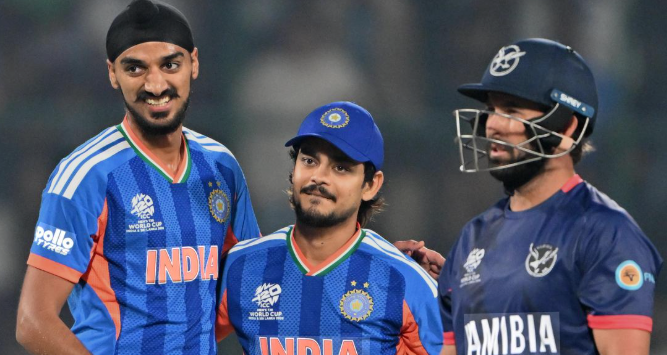
The timeline between India National Cricket Team and Namibia National Cricket Team may not contain dozens of matches, but every encounter carries a unique place in cricket history. Their meetings connected two very different cricketing journeys. India entered these contests as a global powerhouse filled with legendary names, while Namibia represented the fearless ambition of associate cricket nations trying to prove themselves on the world stage. From the unforgettable 2003 World Cup clash in Pietermaritzburg to the emotional 2021 T20 World Cup meeting in Dubai, these matches delivered memorable scorecards, star performances, emotional moments, and valuable lessons about cricket’s expanding global reach.
Match Timeline Table (Most Recent First)
Date
Format
Venue
Result
Key Highlights
12 Feb 2026
T20 World Cup (Group A)
Arun Jaitley Stadium, Delhi
India 209/9 beat Namibia 116 by 93 runs
India posted a strong total; Namibia collapsed. Dominant Indian win.
8 Nov 2021
T20 World Cup (Super 12)
Dubai International Cricket Stadium
India 136/1 beat Namibia 132/8 by 9 wickets
Clinical chase. India qualified for next stage with this win.
23 Feb 2003
ODI World Cup (Pool A)
Pietermaritzburg, South Africa
India 311/2 beat Namibia 130 by 181 runs
Sachin Tendulkar scored 152. One-sided contest in India’s favour.
India posted 311/2 with centuries from Sachin (152) & Ganguly (112*)
Namibia never recovered after early collapses
12 Feb 2026
T20I
Moderately One-Sided
Strong Indian total + clinical bowling (Varun 3/7)
Namibia’s middle order collapse
8 Nov 2021
T20I
Most Competitive (Relatively)
Namibia posted a decent 132/8; India chased easily
Early part of Namibia’s innings
The Day Namibia Stepped Into India’s Cricket World
When Namibia walked onto the field against the mighty India National Cricket Team during the 2003 ICC Cricket World Cup, it felt like two different cricket worlds colliding. India arrived with superstars, massive fan pressure, and title ambitions, while Namibia National Cricket Team entered as fearless newcomers trying to prove they belonged on the global stage. The match in Pietermaritzburg was more than a World Cup fixture because it symbolized the growing reach of international cricket. Indian fans expected dominance from Sachin Tendulkar and Sourav Ganguly, but many neutrals supported Namibia’s underdog spirit. Even though the scoreboard heavily favored India, Namibia earned respect for sharing the field with one of cricket’s biggest powers and competing with courage under enormous pressure.
Season
Match/Event
Score
Winning Team
Key Performance
2003 World Cup
India vs Namibia
India 311/2, Namibia 130
India
Sachin Tendulkar scored 152
2003 World Cup
Opening Partnership
244-run stand
India
Ganguly and Tendulkar dominated
2003 World Cup
Namibia Batting Effort
130 all out
India
Deon Kotze showed resistance
2003 World Cup
Bowling Impact
India controlled chase
India
Zaheer Khan took crucial wickets
2003 World Cup Clash in Pietermaritzburg Changed Everything
The 2003 ICC Cricket World Cup meeting between India National Cricket Team and Namibia National Cricket Team in Pietermaritzburg became a landmark moment for both sides. India entered the contest with enormous expectations after a mixed start to the tournament, while Namibia carried the pride of associate cricket nations. Sourav Ganguly wanted his side to dominate early and improve net run rate, so India attacked from the first over. Namibia’s players knew they were facing legends like Sachin Tendulkar, yet they played with courage and enthusiasm. The match eventually turned into a one-sided contest, but it gave Namibia priceless exposure on cricket’s biggest stage. For Indian fans, it was a reminder of the team’s batting power before tougher knockout battles ahead.
Season
Match/Event
Score
Winning Team
Key Performance
2003 World Cup
India vs Namibia, Pietermaritzburg
India 311/2, Namibia 130
India
Sachin Tendulkar scored 152
2003 World Cup
First Official Meeting
181-run victory
India
Ganguly made 112 not out
2003 World Cup
Namibia Chase
130 all out in 42.3 overs
India
Zaheer Khan led bowling attack
2003 World Cup
Match Turning Point
244-run opening partnership
India
Tendulkar and Ganguly dominated
Sachin Tendulkar and Ganguly Turned the Match Into a Batting Lesson
The opening partnership between Sachin Tendulkar and Sourav Ganguly completely changed the rhythm of the 2003 World Cup clash against Namibia National Cricket Team. From the beginning, both batters looked determined to dominate every phase of the innings. Tendulkar mixed elegant drives with quick running between the wickets, while Ganguly punished loose deliveries through the off side. Namibia’s bowlers tried changing lengths and field placements, but the Indian pair stayed in total control. Their massive 244 run partnership became the backbone of India’s huge total. Fans inside the stadium witnessed a batting masterclass filled with timing, patience, and controlled aggression. It was one of India’s most comfortable World Cup batting performances of that era.
Season
Match/Event
Score
Winning Team
Key Performance
2003 World Cup
India vs Namibia
India 311/2
India
Sachin Tendulkar scored 152
2003 World Cup
Opening Partnership
244 runs
India
Ganguly remained unbeaten on 112
2003 World Cup
Batting Dominance
Run rate above 6
India
Tendulkar hit fluent boundaries
2003 World Cup
Namibia Bowling Struggle
Only 2 wickets taken
India
Indian openers controlled innings
Namibia’s Chase Became a Test of Courage
Chasing 312 against the powerful India National Cricket Team was always going to be difficult for Namibia National Cricket Team, but the associate side showed courage throughout the innings. India’s bowlers attacked with discipline from the start, forcing Namibia into defensive strokes and risky singles. Zaheer Khan used pace and movement effectively, while the Indian fielders kept pressure high with sharp catching and aggressive energy. Despite regular wickets, Namibia’s batters continued fighting and looked determined to avoid complete collapse. Deon Kotze and a few middle-order players tried to build partnerships, but India’s bowling strength proved too strong. Even in defeat, Namibia earned admiration because their players kept competing with spirit against one of the biggest teams in world cricket.
Season
Match/Event
Score
Winning Team
Key Performance
2003 World Cup
India vs Namibia
Namibia 130 all out
India
Zaheer Khan took early wickets
2003 World Cup
Namibia Chase
Target of 312
India
Indian bowlers controlled run flow
2003 World Cup
Middle Order Resistance
Small partnerships formed
India
Deon Kotze showed fighting spirit
2003 World Cup
Match Result
India won by 181 runs
India
Strong Indian fielding effort
The Scorecard That Stayed in World Cup History
The 2003 World Cup scorecard between India National Cricket Team and Namibia National Cricket Team remained unforgettable because it captured the complete dominance of an experienced cricket giant against an ambitious newcomer. India’s total of 311 for 2 was built on breathtaking centuries from Sachin Tendulkar and Sourav Ganguly, whose partnership broke Namibia’s confidence early. The batting display combined elegance with ruthless intent, giving fans one of the most commanding innings of the tournament. Namibia’s chase never truly recovered after early wickets, but their determination earned appreciation from neutrals around the cricket world. Beyond the final margin, the match symbolized cricket’s expanding global reach and showed how World Cups create unforgettable moments between established powers and rising associate nations.
Season
Match/Event
Score
Winning Team
Key Performance
2003 World Cup
India vs Namibia
India 311/2, Namibia 130
India
Tendulkar scored 152 from 151 balls
2003 World Cup
Historic Partnership
244-run opening stand
India
Ganguly finished unbeaten on 112
2003 World Cup
Namibia Innings
130 all out
India
Deon Kotze fought with resistance
2003 World Cup
Final Result
India won by 181 runs
India
Zaheer Khan starred with the ball
2021 T20 World Cup Meeting Brought a Completely Different Story
When India National Cricket Team faced Namibia National Cricket Team again during the 2021 ICC T20 World Cup, the atmosphere felt very different from their 2003 meeting. Namibia arrived in Dubai with confidence after impressive performances in the qualifying stages, while India played with freedom after already being eliminated from semifinal contention. The shorter T20 format created a faster and more aggressive contest. India’s experienced batting lineup attacked from the beginning, with Rohit Sharma and KL Rahul dominating the powerplay. Namibia fought hard but struggled against India’s disciplined bowling attack led by Ravindra Jadeja and Ravichandran Ashwin. Despite the result, Namibia earned global respect for reaching the Super 12 stage and challenging stronger international teams throughout the tournament.
Season
Match/Event
Score
Winning Team
Key Performance
2021 T20 World Cup
India vs Namibia
Namibia 132/8, India 136/1
India
Rohit Sharma scored 56
2021 T20 World Cup
Opening Partnership
86-run stand
India
KL Rahul made 54
2021 T20 World Cup
Namibia Batting Effort
132/8 in 20 overs
India
David Wiese fought in middle order
2021 T20 World Cup
Bowling Dominance
India controlled innings
India
Jadeja and Ashwin took 3 wickets each
Virat Kohli’s Emotional Night Added Weight to the Match
The 2021 T20 World Cup clash against Namibia National Cricket Team carried emotional significance because it marked Virat Kohli’s final match as T20 captain of India National Cricket Team. Although India had already been knocked out of semifinal contention, the players wanted to give their captain a memorable farewell performance. Kohli looked calm and relaxed during the chase, while the dressing room atmosphere reflected respect and emotion for his leadership era. Namibia’s players also shared warm moments with Indian stars after the match, showing cricket’s spirit beyond competition. Fans across social media celebrated Kohli’s aggressive captaincy journey and remembered his passion, intensity, and consistency that shaped India’s white-ball cricket during an important generation.
Season
Match/Event
Score
Winning Team
Key Performance
2021 T20 World Cup
Kohli’s Final T20I as Captain
India won by 9 wickets
India
Emotional farewell for Kohli
2021 T20 World Cup
India Chase
136/1 in 15.2 overs
India
Rohit and Rahul dominated
2021 T20 World Cup
Team Bowling Display
Namibia 132/8
India
Ashwin and Jadeja took 3 wickets
2021 T20 World Cup
Post Match Moments
Respectful player interactions
India
Kohli celebrated with teammates
Comparing the 2003 and 2021 Scorecards
The scorecards from the 2003 and 2021 meetings between India National Cricket Team and Namibia National Cricket Team revealed how cricket evolved across two decades. In 2003, India dominated through long ODI partnerships, patient batting, and a huge 311 run total built by Sachin Tendulkar and Sourav Ganguly. Namibia struggled against sustained pressure in the 50 over format. By 2021, the game had become faster and more aggressive in T20 cricket. India chased quickly with attacking intent from Rohit Sharma and KL Rahul, while Namibia showed greater tactical awareness and stronger fielding standards. The two scorecards reflected different cricket eras, different strategies, and Namibia’s steady improvement as an international side competing against one of the sport’s strongest nations.
Season
Match/Event
Score
Winning Team
Key Performance
2003 World Cup
ODI Match in Pietermaritzburg
India 311/2, Namibia 130
India
Tendulkar scored 152
2021 T20 World Cup
T20 Match in Dubai
Namibia 132/8, India 136/1
India
Rohit Sharma made 56
2003 World Cup
Opening Partnership
244 runs
India
Ganguly remained unbeaten on 112
2021 T20 World Cup
Bowling Performance
Namibia restricted to 132
India
Jadeja and Ashwin took 3 wickets each
Conclusion
The rivalry between India National Cricket Team and Namibia National Cricket Team tells a story bigger than wins and losses. India’s dominance through batting depth, tactical control, and world class players created unforgettable scorecards, while Namibia earned admiration for courage, growth, and determination against elite opposition. The 2003 World Cup showcased the brilliance of Sachin Tendulkar and Sourav Ganguly, while the 2021 T20 World Cup highlighted modern aggressive cricket and Virat Kohli’s emotional farewell as captain. Even with only a few meetings, the timeline remains memorable because it reflects cricket’s ability to unite established giants and rising nations on the same global stage.